
Wait… How Much am I Going to Spend on Rent??
One of the biggest complaints I hear right now is about how expensive housing is. I agree! It’s insane how much prices have gone up, and it doesn’t help that rates are high as well.
Looking at the Numbers: Buying vs. Renting
I put together some numbers to help us understand what it really looks like to rent long-term. On one side of this spreadsheet, I calculated a $5,000-ish payment per month (including taxes and insurance) if you bought a $700,000 house, put 10% down, and got a 7% interest rate. You are looking at $1.825 million that you would pay over the 30 years. That’s a shocking number!
Now, let’s see what it looks like if you rent for the same period (30 years). I assumed you rent the same house for about $3,500 per month. If anything, this number is on the low side. I assumed rent increases by 3.5% per year, but historically it’s been significantly higher than that. So, these numbers are very conservative. You’ll pay $2.26 million in rent over the same 30 years.
Here’s the full comparison:
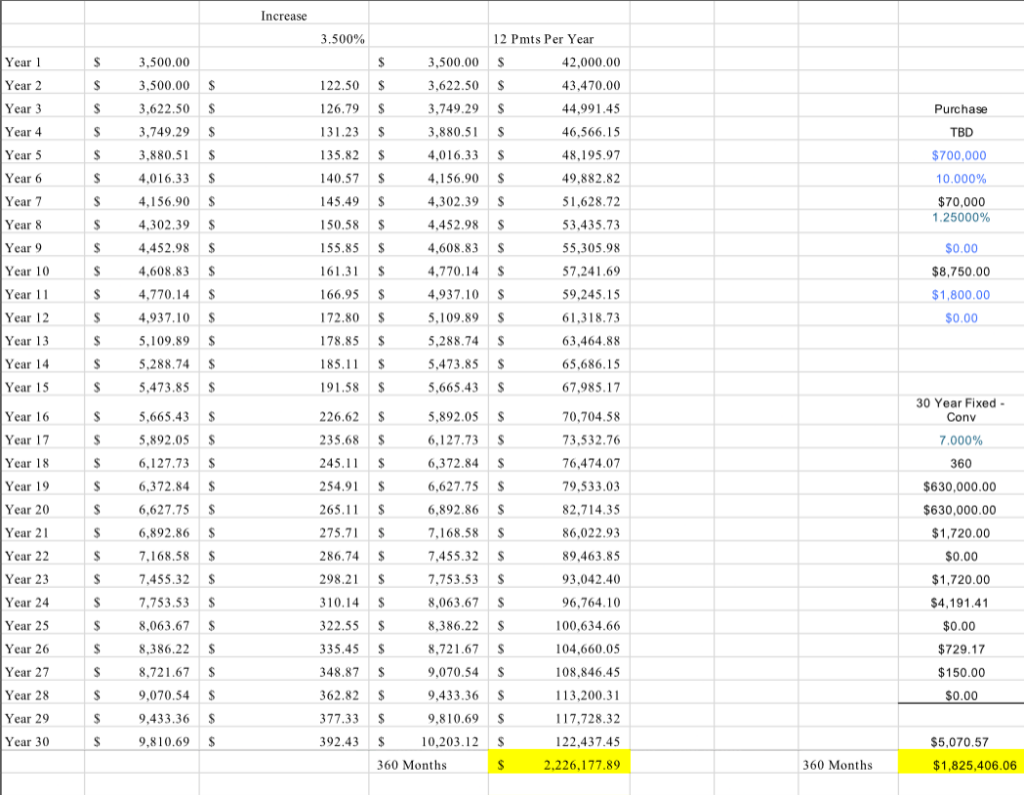
So, it’s a $400,000 upside bonus to buy the house instead of renting a house. It makes a ton of sense when you look at the long-term perspective. There are 400,000 reasons to buy instead of rent!
Cashflow and Property Value Over Time
Also, let’s not forget the other thing that is important about these numbers. We are looking at things from a pure cashflow perspective – comparing buying vs. renting over a 30-year period.
The other part that is really amazing is that you own the house free and clear. Also, if you apply appreciation calculated at historical averages (4.5% per year), it doubles every 15 years. So, it will double twice in the 30 years: the value of the home goes from $700,000 to $1.4 million to $2.8 million if the next 30 years do the same thing as the last 60 years.
It’s interesting to look at these numbers. Also, consider that the following 10 years: you could either be living in a mortgage-free home, or your rent will continue to go up.
History Gives Us Clues
There is a lot of history that says the numbers will pan out. If anything, I am being conservative on both sides. To be fair, I realize that not everyone thinks about it being a full 30-year purchase when buying a home. Maybe you move somewhere else. But if you keep this in mind, it still is a benefit to buy when you are looking at the long-term picture.
The numbers are compelling! Again, I acknowledge that things are high right now. But if you buy, then you can lock in the mortgage price. On the other hand, renting will continue to increase your monthly payments.
If you have questions or need personalized advice, reach out any time. I’m always here to help!
Bill is happy to run the numbers for you, with no pressure.